


Latest articles



Follow Us



These are the questions to ask a builder before you sign, grouped into four areas: registration and insurance, the contract and the money, program and people, and quality and handover. Each one comes with what a good answer sounds like and what a poor answer sounds like, because a question with no standard for judging the reply is not much use across a table.
This article assumes you have already shortlisted. You are sitting with a contract in front of you and you want to know what to test before signing it. Choosing and comparing builders is covered separately in our guide to choosing a luxury home builder in Melbourne.
Victorian requirements stated below are current as at 23 September 2026. Several change when the Domestic Building Contracts Amendment Act 2025 commences, which Consumer Affairs Victoria states will be by 1 December 2026. Those changes are flagged where they apply.
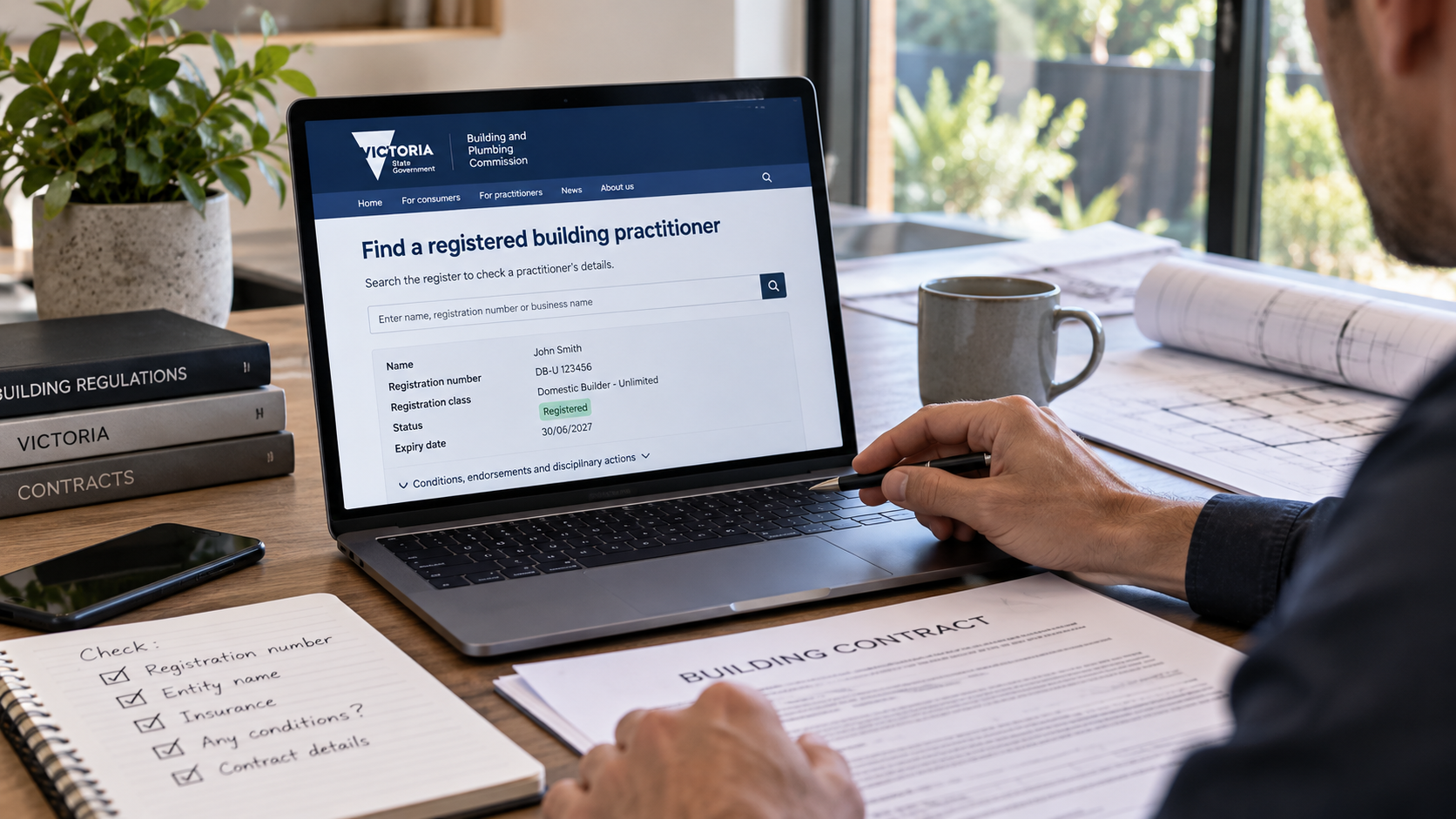
Why it matters: The public register shows the class of work a registered building practitioner may carry out and any conditions on it. A major domestic building contract must also state the registration number as it appears on the registration certificate (Consumer Affairs Victoria, Preparing a major domestic building contract, last updated 8 July 2025).
A good answer: The number, immediately, with an invitation to check it. The Building and Plumbing Commission's guidance on finding and checking a practitioner is blunt: "Check their details before signing a contract or allowing work to start."
A poor answer: Redirection to reputation or years in business, or a number belonging to someone else in the company.
Get in writing: The number in the contract. ROMAAC publishes DB-U 100420 and CD-BU 100477 with our licences and registrations.
Why it matters: Registration can sit with an individual while the contract sits with a company, and the names are not always the same.
A good answer: Both names, and the structure explained.
A poor answer: "It is all the same business," offered instead of the detail.
Get in writing: The legal entity name and ABN on the contract, checked against the register.
Why it matters: Disciplinary action, prosecutions, suspensions and conditions appear on Victoria's public compliance and enforcement register, so this tests candour more than history.
A good answer: A direct yes or no, and if yes, what happened and what changed.
A poor answer: Irritation at being asked, or a denial the register contradicts.
Get in writing: Nothing. Check the register yourself.
Why it matters: For contracts signed on or after 1 July 2026, Home Warranty replaced Domestic Building Insurance. It is required for eligible domestic building work valued at more than $20,000, and the Building and Plumbing Commission is now the sole provider, issuing a Notice of Cover once it accepts the premium (Building and Plumbing Commission, Home Warranty, last updated 30 June 2026).
Consumer Affairs Victoria's published advice remains blunt: do not pay the deposit until the builder gives you a certificate of currency for your property. That wording predates the new scheme, so on a contract signed today the document you are waiting for is the Notice of Cover. The builder must pay the premium before the earlier of ten business days after the contract is signed, or the work starting, so there is no legitimate reason for the paperwork to lag behind your deposit.
A good answer: Yes, before the deposit, as routine.
A poor answer: "We will sort that out once we get going." There is no acceptable version of this answer.
Get in writing: The Notice of Cover, in your hands, before any money moves. If your contract was signed before 1 July 2026, the equivalent document is a Domestic Building Insurance certificate of currency, and that policy continues under its original terms.
Why it matters: Insolvency is the largest financial risk you carry into a build. Home Warranty covers major defects, which the Building and Plumbing Commission defines as structural, waterproofing and weatherproofing, for up to six years after the work is completed, and other defects or non-compliant work for up to two years, with a maximum of $400,000 in total assistance per home.
Unlike the Domestic Building Insurance it replaced, Home Warranty is not limited to situations where the builder has died, disappeared or become insolvent. It is still a safety net rather than a substitute for choosing a solvent builder, and it does not give you back the year you lose.
A good answer: A calm one. A builder comfortable discussing workload, capacity and payment practices has nothing to manage in that conversation.
A poor answer: Offence, or "we're flat out" offered as evidence of health.
Signals worth checking: progress claims running ahead of completed work, trades or suppliers reporting late payment, a jump in live sites without more supervisors, or a recent change of entity or ABN.
Get in writing: The payment schedule. Payments that trail completed work protect you better than any assurance.
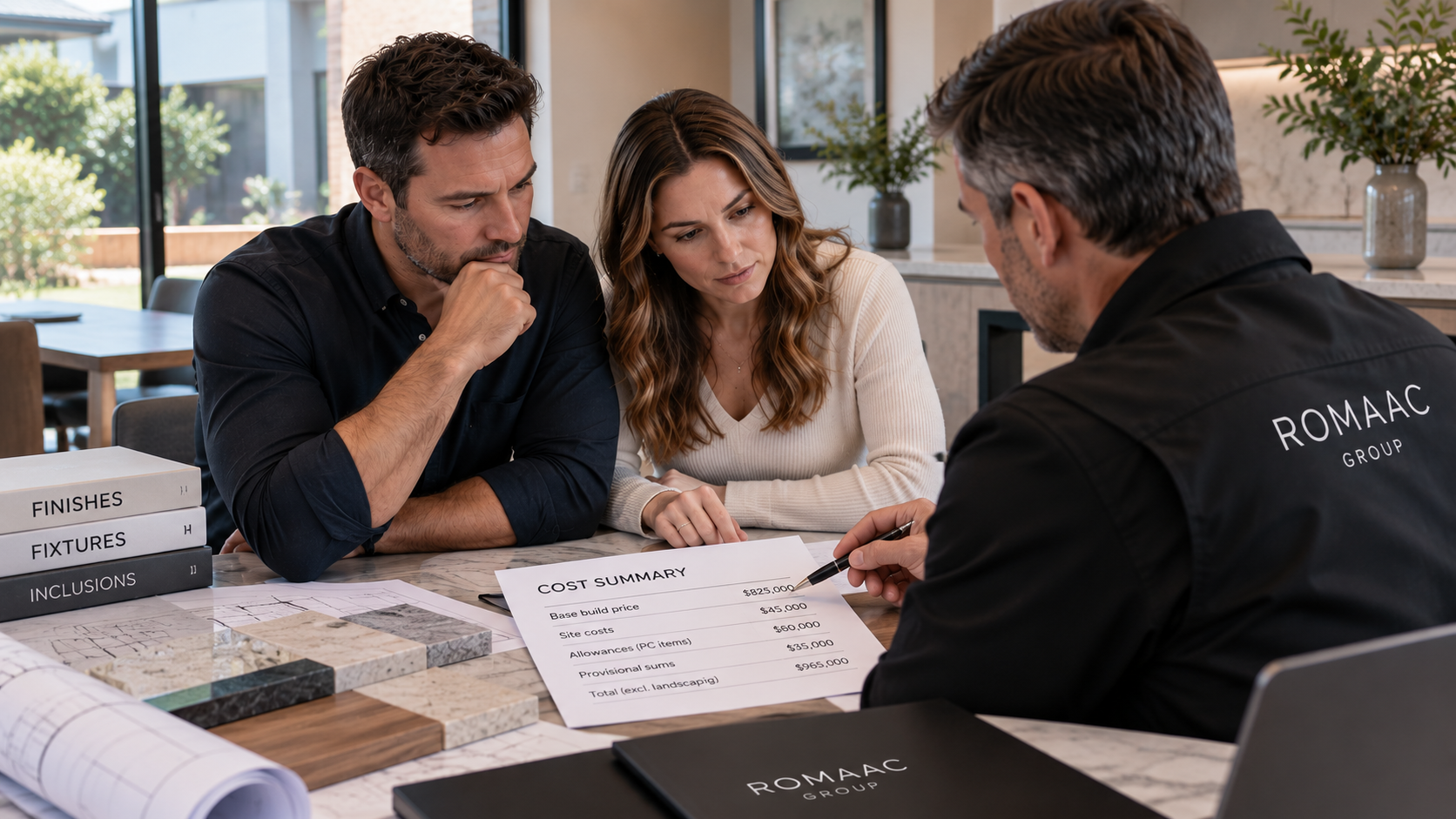
Why it matters: If building work involves more than one trade and is worth more than $10,000, you must have a major domestic building contract before work starts (Consumer Affairs Victoria, Building contracts, last updated 19 October 2025). The same regulator requires it to be in clear English, set out all terms in full, describe the work in detail, name the parties, and state the registration number, the contract price and the payment schedule.
A good answer: Yes, a named standard or solicitor-prepared contract, handed to you in full.
A poor answer: A quote or letter of engagement described as "the contract".
Get in writing: The complete contract with every schedule and annexure attached.
Why it matters: The builder is required to give you sufficient time to have the contract documents reviewed by your legal representative before signing (Consumer Affairs Victoria, Building contracts, last updated 19 October 2025). Pressure to sign in the room is itself the answer.
A good answer: Yes, take it away, here is the full document set.
A poor answer: A price expiring this week, a program slot about to be lost, or the suggestion that legal review is unnecessary between people who trust each other.
Get in writing: Nothing. Just take the contract home.
One trade-off is worth understanding, and it is about to disappear. Consumer Affairs Victoria states a client has five business days from receiving the signed copy of the contract to change their mind, and that this cooling-off period does not apply where the client engaged a lawyer to check the contract before signing.
That exception is being removed. The Domestic Building Contracts Amendment Act 2025 lets an owner exit during the five-day period even after obtaining legal advice, and the new laws take effect by 1 December 2026. Until they commence, taking legal advice still costs you the cooling-off period. Take the advice anyway. Five days to change your mind is worth far less than a lawyer reading the clauses that bind you for the next year.
Why it matters: Deposits are capped. Your deposit cannot be more than 10% for contracts under $20,000, or 5% for contracts of $20,000 or more, according to Consumer Affairs Victoria (Deposits and payments, last updated 30 June 2026). For a custom home, that is the 5% figure.
A good answer: A figure at or under the cap, payable after signing and after you hold the Notice of Cover.
A poor answer: A larger deposit justified by materials orders, or any request for money before there is a signed contract.
Get in writing: The amount and the trigger for paying it.
Why it matters: Payments should attach to completed stages, not to dates, so you can stand on site and see what you are paying for. Consumer Affairs Victoria publishes maximum percentages by stage: for a contract covering all stages, 10% at base, 15% at frame, 35% at lock-up and 25% at fixing (Deposits and payments, last updated 30 June 2026).
Note that different schedules apply to contracts that stop at lock-up or fixing stage, so check which schedule your contract is built on before comparing the percentages.
A good answer: Stage-based claims tied to defined physical milestones, with a named person verifying completion before invoicing.
A poor answer: Monthly payments, or claims "roughly in line with the program".
Get in writing: Each stage defined in words you could argue about later, and the process for disputing a claim.
Why it matters: "High-end finishes" is not a specification. A named product schedule is. The gap between the two is where most budget disputes on premium builds begin.
A good answer: A written specification and schedule of finishes with brands, ranges and model numbers, plus an explicit exclusions list. On our Camberwell project the finishes are named down to the marble benchtops, veneer joinery, tapware brand and porcelain tiles.
A poor answer: "Everything is included," with no document behind it, or a schedule naming categories rather than products.
Get in writing: The specification, the schedule of finishes, and a separate exclusions list.
Why it matters: These are the two mechanisms through which a price that looks fixed stops being fixed, and on high-end builds the exposure is larger, because more of the budget sits in stone, joinery, tapware, appliances and landscaping.
A good answer: An itemised list of every allowance, the assumption behind each figure, and which are most likely to move.
A poor answer: A long list of allowances presented as a fixed price.
Get in writing: Every allowance and how the difference is settled if actual cost lands above or below it.
Why it matters: A variation agreed verbally on site and priced afterwards is the most common way a build quietly exceeds budget. The order matters: priced, then approved, then built.
A good answer: Every variation in writing, priced before approval, signed on both sides, and reflected in an updated contract sum you can see.
A poor answer: "We'll square it up at the end," or a process where site staff can commit you to cost.
Get in writing: The variation procedure and a standing instruction that no unpriced variation proceeds.
Why it matters: A rise and fall clause lets the price change with the builder's costs. Under current Victorian law these clauses are prohibited unless the contract price is more than $500,000, and the clause must be in a form approved by the Director of Consumer Affairs Victoria, which states the Director has not yet approved any cost escalation clauses.
The practical effect is that on a domestic contract signed today, there is no usable escalation clause. That changes: under the Domestic Building Contracts Amendment Act 2025, escalation clauses become available for contracts worth $1 million or more and are capped at adding 5% to the contract price, with the new laws taking effect by 1 December 2026 (New domestic building contract laws passed in Victoria, published 15 September 2025).
A good answer: A direct statement that there is no enforceable escalation clause in your contract today, and clarity about what the builder intends once the new provisions commence.
A poor answer: Not knowing, or calling a rise and fall clause standard without pointing to the clause.
Get in writing: Every clause capable of moving the price, not only escalation. Provisional sums, prime cost items and the variation procedure move far more money in practice.

Why it matters: A stated period is only as meaningful as the list of reasons it can be extended. Most disputes about time are really disputes about which delays were allowable.
A good answer: A period stated in the contract, a clear extension of time clause, and a willingness to talk through which delays qualify.
A poor answer: A confident verbal estimate with no contract period.
Get in writing: The period, the extension provisions and any liquidated damages.
Why it matters: This is the honest version of "will you be on site". Overextension shows up in the program before it shows up anywhere else.
A good answer: A specific number, the stage each project is at, and how supervision is resourced across them.
A poor answer: A reassurance about always having time for every client.
Get in writing: Nothing contractual, but record the number and the date.
Why it matters: The person who wins the work is often not the person who runs it. You need to know who holds the site and who you call when something is wrong.
A good answer: Named individuals, their roles and the escalation path. Our project management service sets out how ROMAAC structures that oversight.
A poor answer: "You'll always be able to get hold of someone."
Get in writing: The named site supervisor and contract administrator, and what happens if either leaves.
Why it matters: Neither answer is wrong, but it changes who controls quality and scheduling, and how fast a defect gets fixed. A builder who cannot answer cleanly does not have a firm grip on their own business.
A good answer: A trade-by-trade breakdown, and how subcontracted trades are selected and supervised.
A poor answer: "We use our own people," on a build plainly involving a dozen trades.
Get in writing: The key trades, marked in-house or subcontracted.
Why it matters: Reporting cadence is a proxy for how the business runs. Builders who report on a rhythm tend to be the ones who know what is happening.
A good answer: A stated frequency, format and sender. Photographs, a program update and a cost position are the three worth having.
A poor answer: "Whenever there's something to report."
Get in writing: The reporting commitment, in the contract or in an email you keep.
Why it matters: A design that cannot be built as drawn has to change, and someone carries that cost. Settling responsibility before signing is far cheaper than settling it at frame stage.
A good answer: Who is responsible for buildability, and what happens to cost and program when engineering forces a design change.
A poor answer: "That's between you and your architect."
Get in writing: The order of precedence between drawings, specification and engineering.
Why it matters: These are two different protections and clients routinely confuse them. A defects liability period is a contract term, not a statutory one. Victorian law sets no minimum, so a builder offering three months and a builder offering twelve are both compliant, and the difference is yours to negotiate before signing.
The statutory protections sit alongside it and cannot be contracted out of. Consumer Affairs Victoria lists the implied warranties a builder owes under the Domestic Building Contracts Act 1995 (Vic): carrying out the work in a proper and workmanlike manner in accordance with the plans and specifications, supplying materials that are good, suitable and new, complying with all laws, working with reasonable care and skill and finishing within the period specified, and delivering a home suitable for occupation.
Those warranties transfer to a new owner for up to 10 years from completion (Implied warranties and domestic building insurance checklist, last updated 8 April 2026). Home Warranty cover runs alongside them, and Australian Consumer Law guarantees apply as well. A short contractual defects period does not shorten any of it.
A good answer: The defects period cited to its contract clause, a written reporting and rectification process, a response time, and an accurate account of what the statutory warranties and Home Warranty cover.
A poor answer: A verbal "we look after our clients", or statutory periods quoted from memory.
Get in writing: The defects clause, the reporting process, the response time, and every manufacturer warranty handed over at completion.
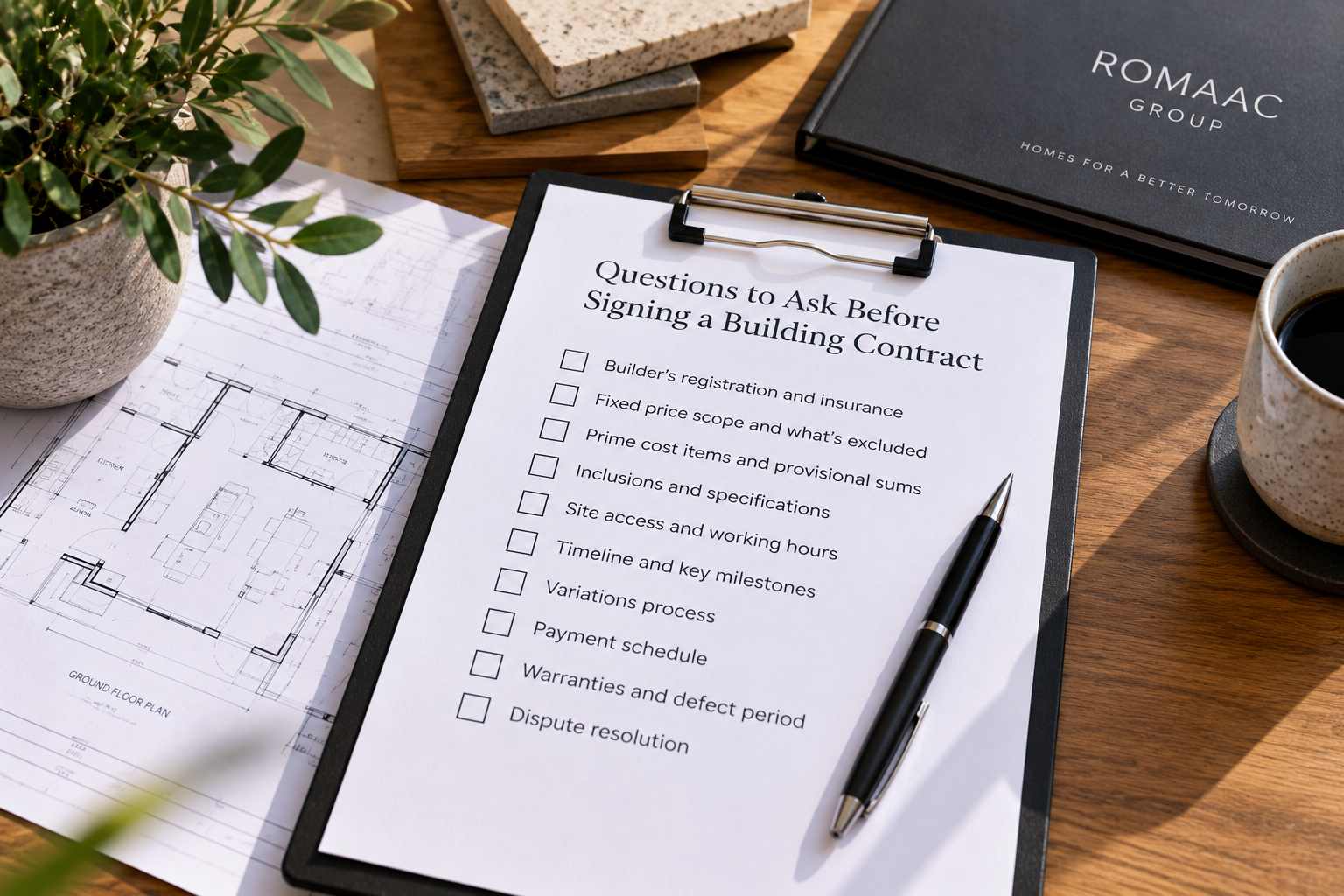
We expect to be asked all twenty. ROMAAC Group is a registered building practitioner in Victoria and Queensland, publishes registration numbers DB-U 100420 and CD-BU 100477, and answers these questions in the ordinary course of business.
If you are at the contract stage, a pre-construction consultation is the place to work through the specification, the allowances and the program before anything is signed. Bring the checklist. Bring the other builder's contract too.
Assess a builder on what you can verify rather than on impression: registration status and history on the public practitioner register, the completeness of the contract and specification they hand you, the structure of their deposit and progress payments, and how specific they are about people, program and allowances.
There is no single test, but there are checkable signals: progress claims made ahead of work completed on site, suppliers or subcontractors reporting late payment, a jump in live sites without more supervisors, pressure for larger or earlier payments, and a recent change of entity or ABN.
Settle four things before signing: what you are building, specified to product level; what it costs, including every provisional sum and prime cost item; how long it takes, with allowable delays named; and who is accountable day to day.
Judge it yourself rather than relying on rankings. Check the practitioner register for conditions and disciplinary history, speak to two or three clients whose builds finished more than a year ago, ask what went wrong and how it was handled, and visit a live site.
Consumer Affairs Victoria states that if building work involves more than one trade and is worth more than $10,000, you must have a major domestic building contract before work starts. It must be in clear English, set out all terms in full, describe the work in detail, name the parties, and state the registration number, contract price and payment schedule.
Yes. A contract offered to you is a proposal, and the payment schedule, specification, allowances and variation process are all negotiable before signature. Have changes made as written amendments to the contract document rather than as side letters or verbal understandings.

.svg)

.png)
