


Latest articles




Follow Us


Domestic building insurance (DBI) has been replaced in Victoria. For eligible contracts signed on or after 1 July 2026, the builder must take out Home Warranty instead, issued by the Building and Plumbing Commission (BPC). The difference that matters most to a homeowner is when you can claim. DBI only paid out if your builder died, disappeared or became insolvent. Home Warranty can respond when a builder is unable or unwilling to finish or fix eligible work.
This article explains which scheme covers your build, how the two compare, and where the insurance turns up at each stage of a real project, from before you sign to after handover.
The date your contract was signed decides it.
If you signed a domestic building contract before 1 July 2026, your project is covered by DBI on the terms of the policy that was issued. Those policies stay with their original insurer and do not transfer to the new scheme (vic.gov.au, Home Warranty Insurance).
If you signed on or after 1 July 2026, and the work is eligible, it falls under Home Warranty. BPC is the only provider, because the private domestic building insurance market closed on that date (BPC, Home Warranty insurance coming soon).
If a project straddles the change, for example a contract signed in June 2026 with work starting in August, the signing date still governs. Check the policy or notice of cover you were given rather than assuming.
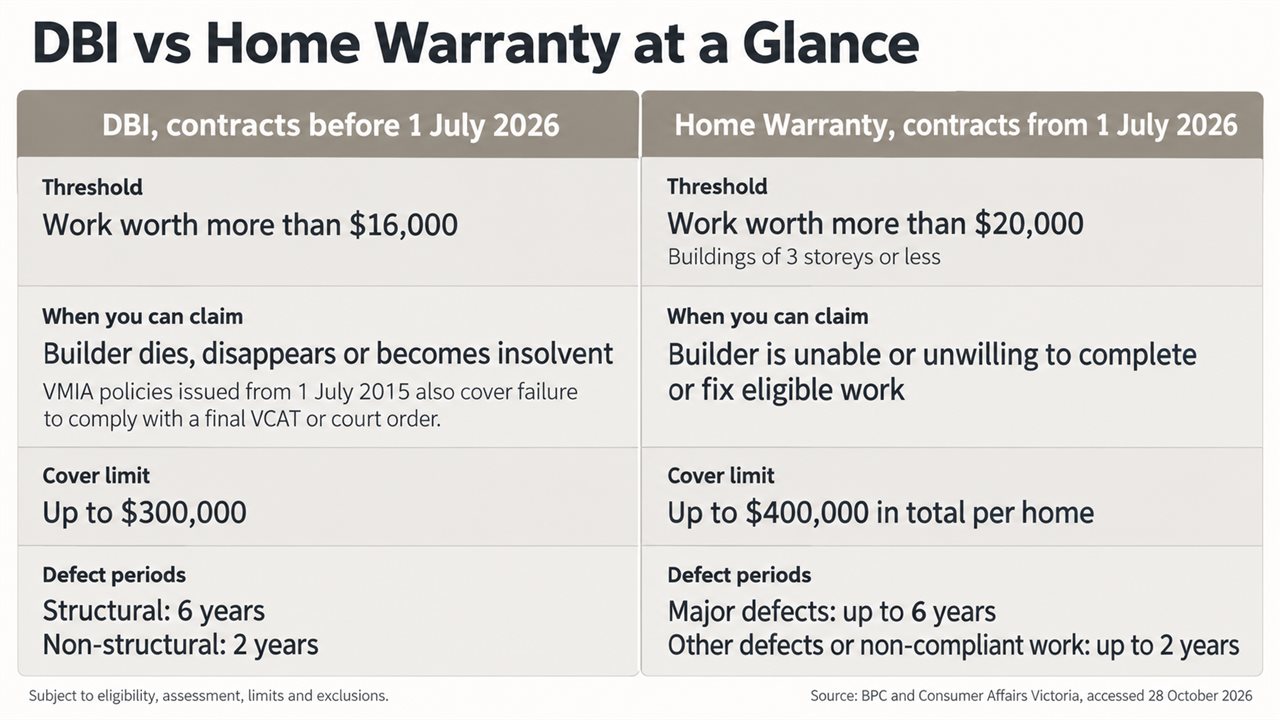
The two schemes cover similar ground. What changed is the trigger for a claim, the limits and the extra costs covered.
DBI figures are from Consumer Affairs Victoria. Home Warranty figures are from the Building and Plumbing Commission. Both accessed 28 October 2026.
The biggest practical shift is the first row that changed: when you can claim. Under DBI, a builder who was solvent but simply would not come back to fix a defect left the homeowner pursuing it through VCAT or the courts, at their own cost, before insurance became relevant. Home Warranty is designed to step in earlier.
One point of wording to note. BPC describes the six year period as covering major defects, where DBI referred to structural defects. Do not assume the two definitions are identical. If a defect sits near the line, check the current BPC definition rather than the old one.

The insurance only protects you if the job is set up correctly from the start, so the checks happen before the contract is signed.
Check the builder is registered. Work that must be done by a registered builder but is done by an unregistered one may leave you without protection, which BPC states directly. You can search the register on the BPC website before you commit.
Check the work is eligible. Home Warranty applies to work valued at more than $20,000 on buildings of three storeys or less. That includes a new home, repairs, alterations and extensions, residential buildings up to three storeys with more than two homes, and pool-related domestic building work. Residential buildings of more than three storeys with more than two homes are excluded.
Check the contract. A major domestic building contract should deal with the insurance. If it is silent, ask before you sign, not after the slab is poured.
The same conversation is a good point to work through the rest of your pre-contract questions about scope, variations and program, because they all affect what a claim would look like later.

Once the contract is signed, the obligation sits with the builder.
The builder pays the Home Warranty premium. BPC requires it to be paid before the earlier of 10 business days after the contract is signed, or the building work starting. Cover starts from the earliest of three events: the premium being paid, the work starting, or the major domestic building contract being signed (BPC, Home Warranty).
You should then receive a notice of cover. Keep it with your contract. You can check that a notice is genuine through the BuildVic verify notice of cover portal.
If work starts on site and you have not received one, raise it with the builder that week. It is a simple question and the answer tells you a great deal.
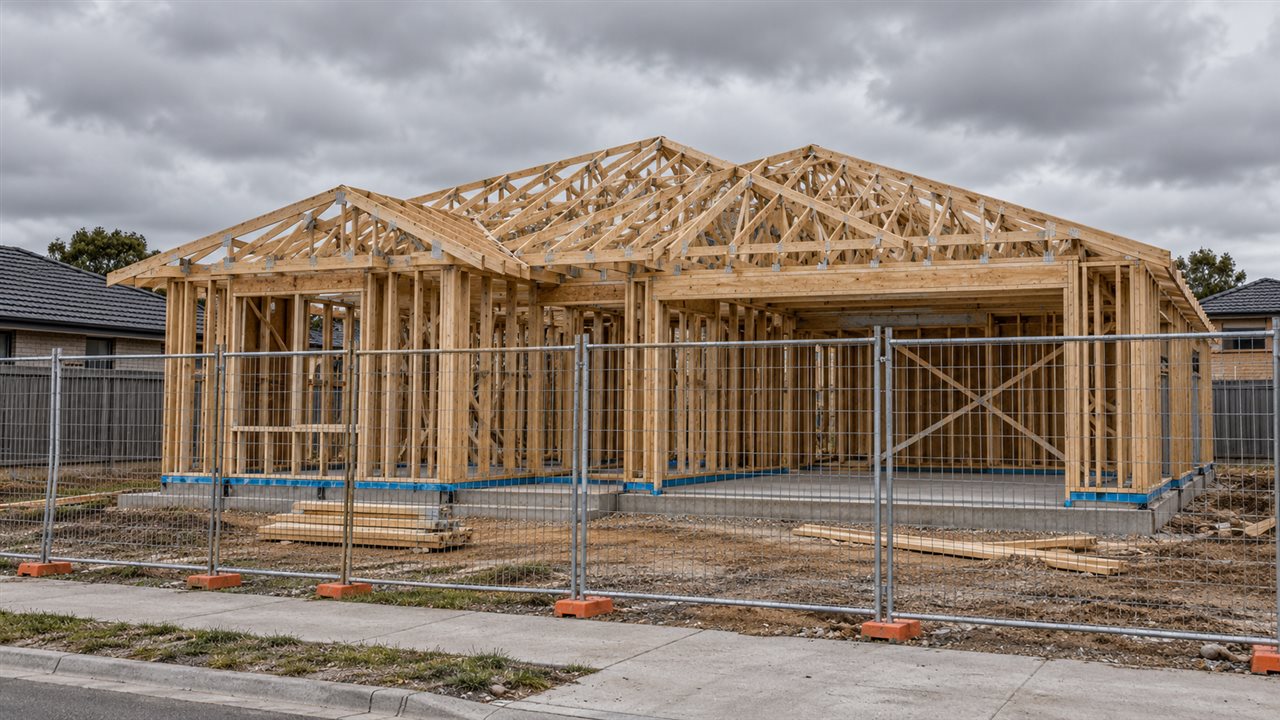
Most builds finish without anyone thinking about the insurance again. It matters when a job stalls.
Under Home Warranty, the cover can extend to work that is incomplete, along with related costs: lost deposits where work has not started, accommodation, removal and storage, and the cost of securing an incomplete site. Consumer Affairs Victoria also lists cover for 5% of the deposit. All of this is subject to eligibility, assessment, limits and exclusions.
Under DBI, a claim for unfinished work may be limited to 20% of the contract price, and advance payments are not covered. That is a material difference for anyone whose builder walks away mid-frame.
Whichever scheme applies, the protection works best alongside good records. Keep your contract, variations, invoices, payment receipts and site photos in one place from day one. Clear project management through the build makes that record largely automatic.
Cover continues after the house is finished, for set periods measured from completion.
Under Home Warranty, major defects are covered for up to six years and other defects or non-compliant work for up to two years. Under DBI, structural defects are covered for six years and non-structural defects for two years.
Minor cosmetic differences from the contract plans and specifications are not covered under Home Warranty. BPC has a separate determination on what counts, so check it before assuming a finish issue is claimable.
The practical point is timing. A two year window passes quickly, and defects in finishes, waterproofing and services often show up in the first year or two of living in a house. Report them in writing as they appear rather than saving them up.
“First resort” does not mean you skip the builder.
BPC’s guidance is that in most cases you should first try to resolve the problem with the builder, and keep records as you go: photos, inspection reports, emails and letters. A Home Warranty claim becomes available where the builder is unable or unwilling to complete or fix eligible work.
What has changed is that you no longer need the builder to have died, disappeared or gone insolvent before insurance can respond. Under the old scheme, a solvent builder refusing to rectify a defect meant a homeowner paying for legal action first. BPC’s stated aim for the new cover is to save homeowners that time and money.
If your contract was signed before 1 July 2026, your DBI policy still works the old way. The last-resort triggers apply, so a dispute with a solvent builder generally goes through the BPC’s dispute resolution service (formerly DBDRV) and VCAT rather than to the insurer.
Home Warranty is not limited to new homes. Repairs, alterations, extensions and pool-related domestic building work are all eligible where the work is valued at more than $20,000.
That matters because renovation and extension work is where many homeowners least expect a formal insurance requirement. If you are planning a home extension or a substantial renovation, the same checks apply: a registered builder, an eligible contract, and a notice of cover before work starts.
Owner-builder work sits outside the registered builder contract this article describes, and the insurance requirements for it are different. If you are building as an owner-builder, or buying a house an owner-builder built, check the current requirements directly with BPC before relying on any summary, including this one.
The builder. Under both DBI and Home Warranty, the registered builder is responsible for arranging the cover and paying the premium. For Home Warranty, the premium must be paid before the earlier of 10 business days after the contract is signed or the work starting. You should receive a notice of cover, and you can verify it through the BuildVic portal.
The premium is paid by the builder and forms part of the overall contract price, so it is not a separate bill the homeowner arranges. Premiums are set by BPC and vary with the project. If you want to understand how insurance and other costs sit within your build price, ask your builder to walk you through the contract before you sign.
Under Home Warranty, eligible work that is incomplete, defective or non-compliant, plus related costs such as lost deposits where work has not started, accommodation, removal and storage, and securing an incomplete site, up to $400,000 per home. Under DBI, repair costs up to $300,000 when the builder has died, become insolvent or disappeared, or for VMIA policies from 1 July 2015, failed to comply with a final VCAT or court order.
For domestic building work in Victoria, there is nothing to shop around for. From 1 July 2026, BPC is the only provider of Home Warranty, and the builder arranges it, not the homeowner. Home and contents insurance on a finished house is a separate product that you do choose yourself.
No. DBI policies issued before 1 July 2026 stay in force on their existing terms with their original insurer. They do not transfer to Home Warranty. If your contract was signed before that date, your DBI policy is the one that applies.
Yes. Home Warranty applies to eligible domestic building work valued at more than $20,000. Under the old DBI scheme, the threshold was work worth more than $16,000.
The insurance is the part of a build nobody wants to use, and the part you most need to have set up correctly on day one. Confirm which scheme covers your contract, make sure you hold a notice of cover before anyone breaks ground, and keep your records from the start.
If you are planning a build and want to talk through how the contract, insurance and program fit together, get in touch with the ROMAAC team.
This article is general information about Victorian domestic building insurance and Home Warranty, current at the date of last review. It is not legal or insurance advice. Check the Building and Plumbing Commission for the requirements that apply to your contract.
Building and Plumbing Commission, Home Warranty. Page last updated 30 June 2026. Accessed 28 October 2026.
Building and Plumbing Commission, Home Warranty insurance coming soon. Accessed 28 October 2026.
Consumer Affairs Victoria, Domestic building insurance and insolvency. Accessed 28 October 2026.
Victorian Government, Home Warranty Insurance. Page last updated 27 October 2026. Accessed 28 October 2026.
BuildVic, Verify Notice of Cover. Accessed 28 October 2026.


