


Latest articles



Follow Us


A cost plus contract means you pay the actual cost of the building work plus the builder’s fee. A fixed price contract sets the price for an agreed scope of work when you sign. The difference decides who carries the risk if costs rise, how much certainty you have, and how much paperwork comes with the build.
In Victoria, the choice is not entirely yours. Cost plus contracts are generally prohibited for domestic building work under $1 million, and Victoria’s domestic building contract laws are changing by 1 December 2026. This guide explains both contract types, what the law allows, and how each works from pricing through to the final payment.
Under a cost plus contract, the owner pays the actual costs of the work, such as labour, materials, subcontractors and site costs, plus a fee to the builder for running the job. The fee is usually set either as a percentage of the costs or as a fixed amount agreed at the start.
There is no final contract price at signing. Instead, the builder provides an estimate, and the owner pays progressively as costs are incurred and documented.
The arrangement depends on open records. Invoices, supplier quotes, subcontractor accounts and timesheets are shared with the owner so they can see what each part of the build actually cost. That transparency is the main appeal of cost plus: the owner sees the real cost of the work rather than a single price. The trade-off is certainty. If materials rise, trades cost more or the scope grows, the owner pays the difference.
A fixed price building contract sets one price for a defined scope of work. If the builder’s costs turn out higher than expected for that scope, the builder generally carries the difference, not the owner.
“Fixed” does not mean the price can never change. It moves when:
In Victoria, fixtures and fittings that are included but not identified, or whose price is unknown, must be clearly stated in the contract as provisional sum or prime cost items (Consumer Affairs Victoria). The fewer allowances a contract carries, the more genuinely fixed its price is.

Victoria’s Domestic Building Contracts Act 1995 shapes which contract you can sign. Under the current rules, as set out by Consumer Affairs Victoria:
(Consumer Affairs Victoria, Preparing a major domestic building contract)
The Domestic Building Contracts Amendment Act 2025 passed the Victorian Parliament on 11 September 2025 and takes effect on a day to be proclaimed, or by 1 December 2026 at the latest (Consumer Affairs Victoria). It applies to contracts entered into from commencement.
Among the changes, cost escalation clauses will be allowed only where the contract price is $1 million or more, and a builder must not use them to raise the total price by more than 5% (Consumer Affairs Victoria). Deposit limits and progress payment stages will be set by new regulations.
If you are signing around this date, ask your builder which set of rules your contract falls under.
The pricing stage looks different under each contract.
For a fixed price contract, the builder needs drawings, engineering, specifications and as many selections as possible before pricing. Every decision left open becomes an allowance, and every allowance is a part of the price that can still move. The more complete the documents, the more meaningful the fixed price. Our pre-construction planning tips explain what to resolve before the builder prices the work.
For a cost plus contract, the owner receives an estimate rather than a price, along with the builder’s fee structure and an agreed method for recording and reporting costs. The estimate is only as good as the information behind it, so complete documents matter here too.
Either way, the work done before the contract is signed decides how predictable the build will be. That is the purpose of pre-construction consultation: resolving the design, selections and site questions while they are still cheap to change.
Whichever type you sign, a major domestic building contract in Victoria has required content. Before signing, check that it clearly states:
Consumer Affairs Victoria also requires builders to give the owner the Domestic Building Consumer Guide before the contract is signed. Read it, and work through your questions for the builder before you sign.

Once work starts, the two contracts are managed differently.
Under a fixed price contract, the key discipline is variations. Any change to the scope should be documented, priced and agreed in writing before the work is done. Provisional sums and prime cost items are reconciled as the actual figures come in.
Under a cost plus contract, the key discipline is records. The owner should receive regular cost reports showing spending against the estimate, with invoices, supplier accounts and timesheets available to check.
Agree at the start how often reports arrive and what they contain.
In both cases, progress payments are claimed as stages of work are completed. Clear, regular reporting through the build is what keeps either contract on track, and it is the core of good project management.
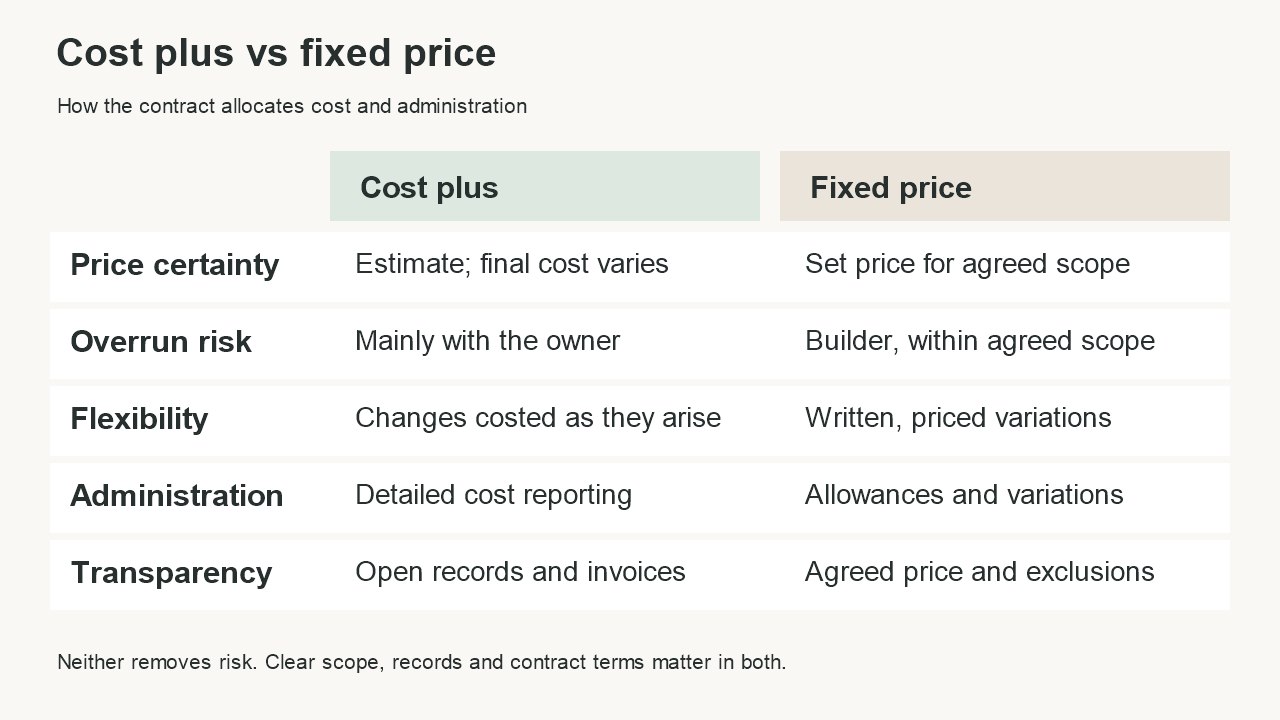
Neither contract is safer by default. Each puts the risk in a different place.
The main disadvantages of a cost plus contract are the lack of a final price at signing, the owner carrying the risk of rising costs, and the extra administration. The main disadvantages of a fixed price contract are that allowances can still move, and that a builder pricing a fixed sum may include a buffer for risk.
For most private homes in Victoria the question is settled by law: below $1 million, fixed price is normally required, subject to the existing-building exception described above.
Above that, a cost plus contract can suit a large, complex or highly custom project where the design will keep evolving during construction, and the owner values transparency and flexibility over a fixed number. A fixed price contract suits owners who want certainty and have a design resolved enough to price properly.
Whichever you choose, the contract type matters less than the quality of the documents behind it and the builder you sign with. A well-documented fixed price contract with few allowances, or a well-run cost plus contract with clear reporting, will both serve you better than a poorly prepared version of either. That is why choosing the right builder comes first.
A cost plus contract is a building contract where the owner pays the actual cost of the work, including labour, materials and subcontractors, plus a fee to the builder. There is no set price at signing. The builder provides an estimate and open records of the costs as the work proceeds.
The owner has no final price at signing and carries most of the risk if costs rise. There is more administration, because costs need to be recorded, reported and checked through the build. In Victoria, cost plus contracts are also not available for most homes, because they are prohibited for domestic building work under $1 million.
A typical example is a large custom home over $1 million where the design will keep developing during construction. The owner agrees the builder’s fee structure, receives an estimate, and pays the documented costs of each stage plus the fee, with regular cost reports showing spending against the estimate.
Only in limited cases. Under the current rules, cost plus is permitted where domestic building work is reasonably estimated to cost $1 million or more. Below that, it is generally prohibited. CAV advises that the existing-building exception allows investigative work needed to set the price, after which a fixed price contract should cover the remaining work.
No. The price for the agreed scope is set, but it can change through variations, and through provisional sums and prime cost items that turn out higher or lower than allowed. The fewer allowances in the contract, and the more complete the design at signing, the more the price stays fixed.
The Domestic Building Contracts Amendment Act 2025 applies to contracts entered into from its commencement, which is by 1 December 2026 at the latest. A contract signed before then generally continues under the rules that applied when it was signed. If you are signing close to that date, confirm with your builder which rules apply.
The right contract is the one that matches how resolved your design is and how much risk you are willing to carry. Settle the design first, and the contract decision becomes much clearer.
If you are weighing up a build and want to talk through how it would be priced and contracted, get in touch with the ROMAAC team.
This article is general information about Victorian domestic building contracts, current at the date of last review. It is not legal advice. Check Consumer Affairs Victoria or seek legal advice for your contract.


