


Latest articles

Follow Us


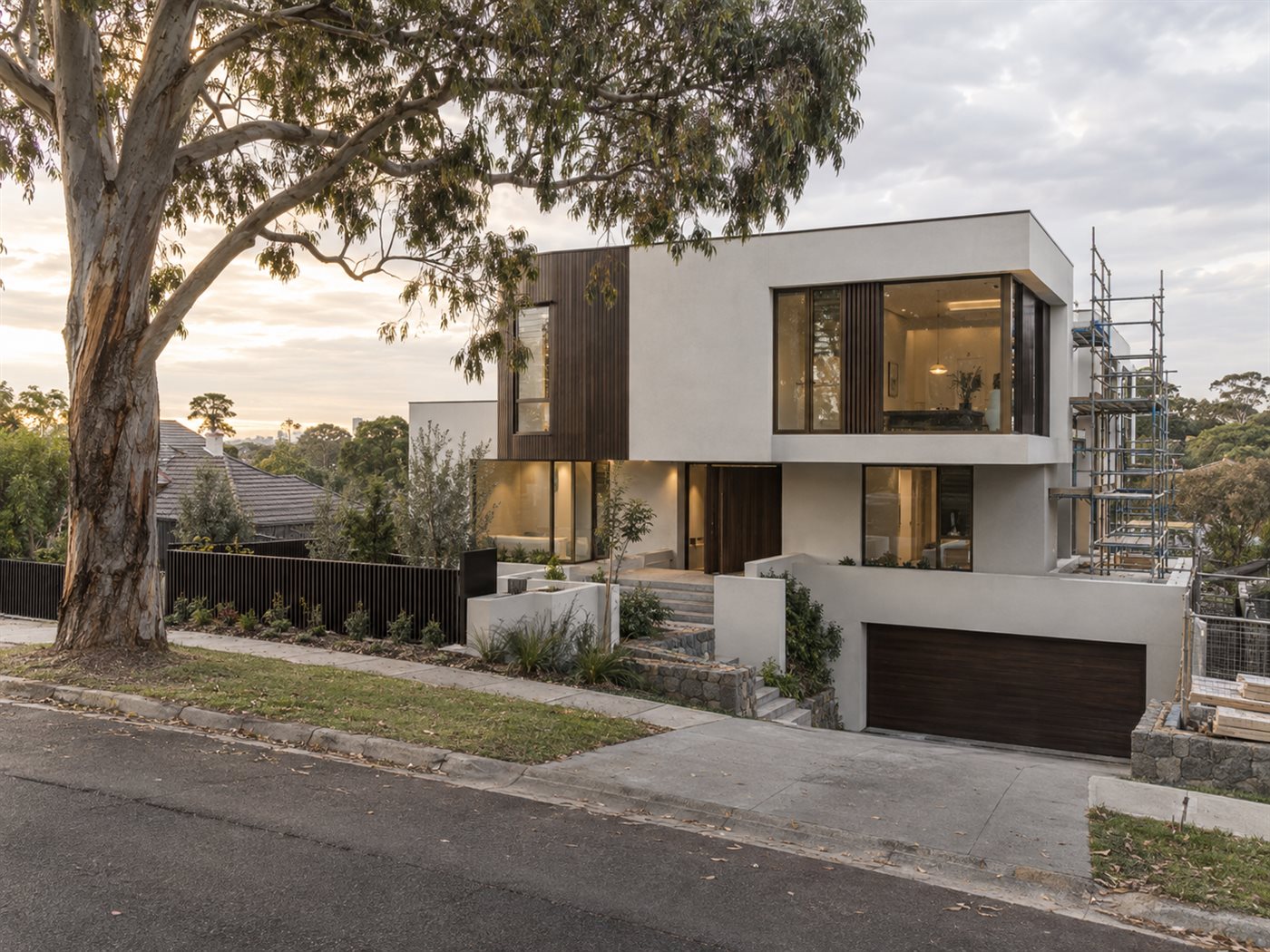

The difference is not a price tag, it is the point at which the price stops moving. A volume builder publishes a low headline figure and leaves parts of it open through prime cost items, provisional sums and an inclusions list that stops short of a finished house. A custom builder prices a complete specification once, then carries the risk of having priced it wrong.
Custom builder vs volume builder is a choice between two contract structures. Victorian law lets a price move in a few defined ways, and each model uses those mechanisms differently. What follows is where your money is permitted to move once you sign.
A volume builder sells a finished design at scale. The plan exists, the engineering is done, the suppliers are contracted, and the margin comes from repetition. Deviation costs that business money, so it is minimised and charged for when it happens.
A custom builder sells capacity and coordination. The design is drawn for your site, the engineering follows it, and the trades are priced against a specification that did not exist before. Margin comes from estimating correctly, so the business fixes as much of it as it can before signing.
Neither model is inherently better built. Both use registered builders, both work to the National Construction Code, both carry the same statutory obligations. The difference is where the unpriced risk sits.
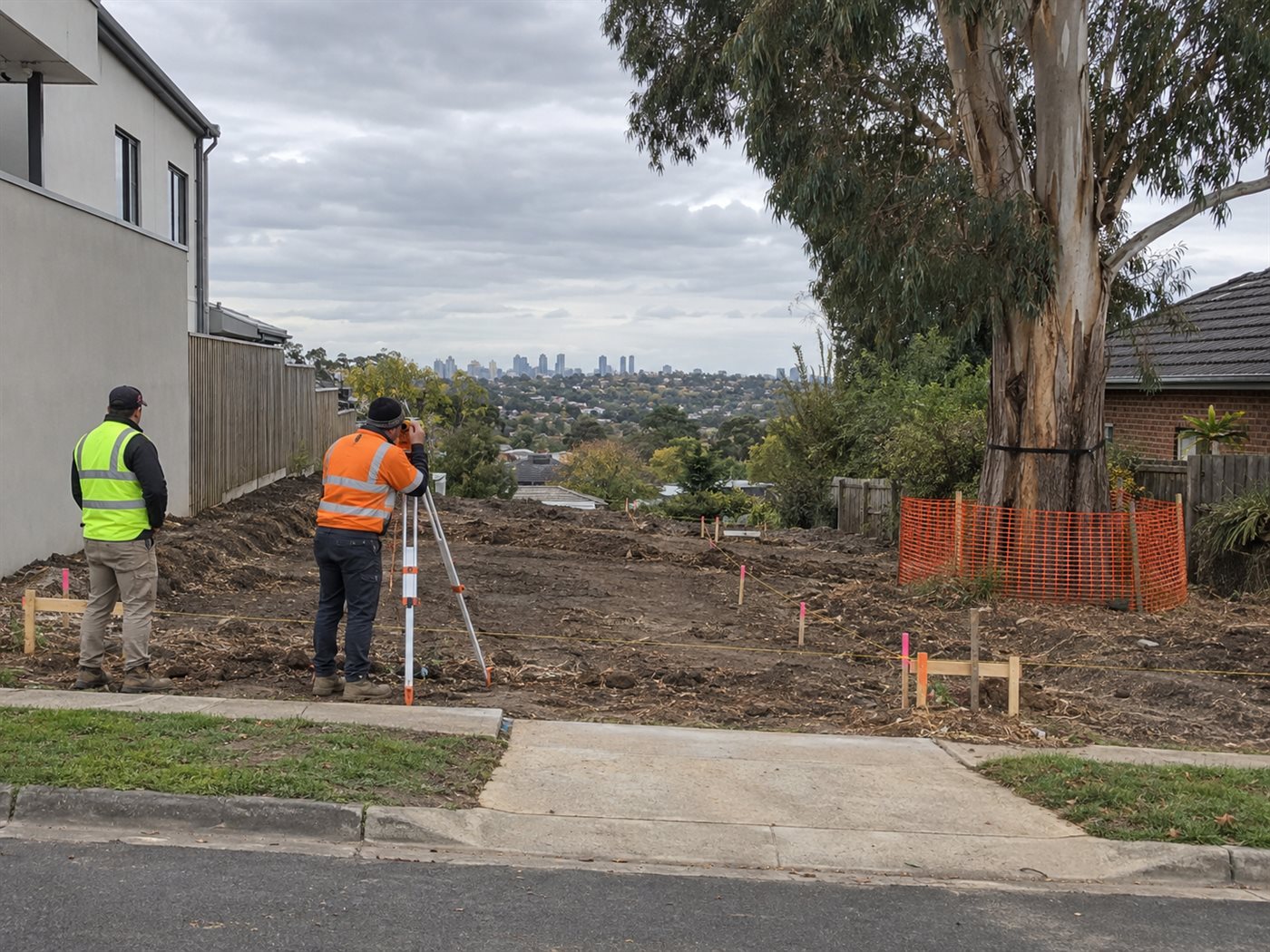
Volume designs are drawn for a rectangular, relatively flat block with a known soil classification and simple street access. An established eastern suburbs site rarely offers all three.
A Camberwell block with a two metre cross-fall, a neighbour's boundary wall, a protected tree and a single crossover breaks the assumptions the standard plan was priced on. The design can usually be made to fit, but every adjustment becomes a variation to a fixed product, priced at the builder's rate rather than the base design's.
A custom builder prices those same conditions once, at design stage, as part of the design.
Soil is where this shows up in the contract. If the site has not been fully investigated, excavation is usually written in as a provisional sum, and on a block going through a knock down rebuild, what is under the slab is unknown until the old house is gone. Both models face that unknown, and only one has a standard price it is measured against.
Lifestyle fit is a site question in disguise. Northern light, the garden's relationship to the living space, whether the kitchen faces the street or the yard: orientation sets all of it. Rotating a volume design to chase the sun changes a product priced on the assumption you would not.
A volume builder gives you a selections process: three benchtop options at the base level, six at the upgrade level, a facade from a fixed set, a colour scheme from a curated palette. That is efficient, fast, and for many buyers sufficient. What it is not is open. Move outside the ranges and you are into variation territory, priced by a business that would rather you stayed inside them.
A custom builder starts with no ranges, so the specification is written from what you chose rather than from what was available. The cost is time and design fees at the front. The benefit is that by the time the contract is drafted, very little is left undecided, and undecided is the expensive state to be in.
Every item still undecided at signing becomes one of two things in Victorian law: a prime cost item or a provisional sum. Both are legitimate, and both are where a contract price stops being a price.
Under Victorian law the maximum deposit a builder can take is 10% for contracts under $20,000, and 5% for contracts of $20,000 or more, according to Consumer Affairs Victoria. The Building and Plumbing Commission publishes the same limits. Every custom home build in Melbourne sits in the second category, so the ceiling is 5%.
The cap applies to both models identically. A builder asking for more than 5% on a major domestic building contract is asking you to agree to something the law does not permit.
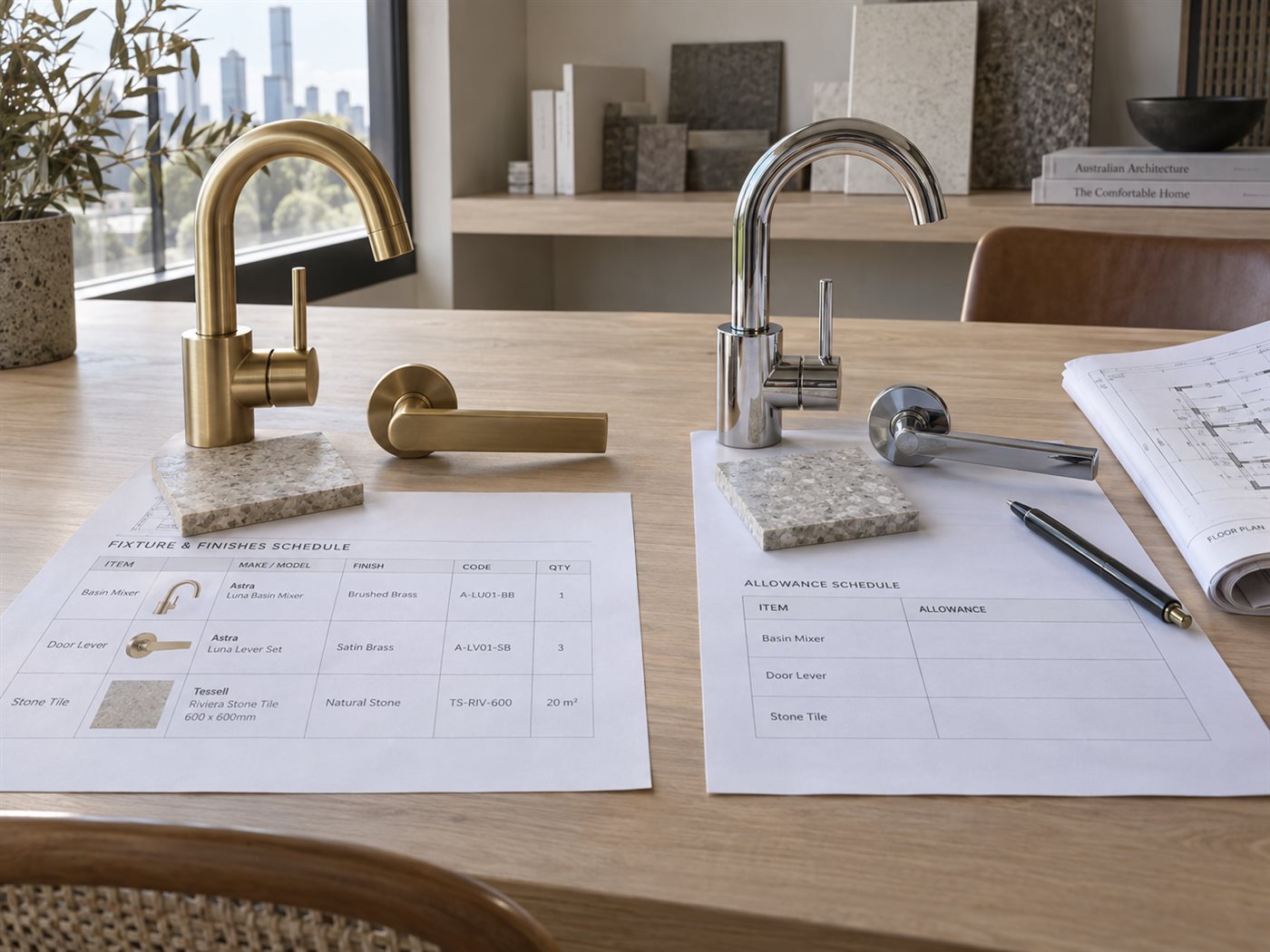
A prime cost item is an item that has not been specified, or whose price is not known, at the time you enter the contract. Taps, handles, tiles and cooktops are the standard examples.
Victorian law requires the contract to list every prime cost and provisional sum item with a breakdown of the cost estimate for each, showing estimated quantities and unit costs. The builder must also give you a copy of any invoice or receipt showing the actual cost, as soon as possible. Consumer Affairs Victoria sets out these obligations under changing a domestic building contract price.
A prime cost allowance is not a price, it is an estimate written in so the total can be presented as a total. Choose a tap that costs more and you pay the difference, plus whatever the contract says the builder charges on top.
Multiply that across every tap, handle, tile, cooktop, oven, sink and light fitting in a high-end house and the gap matters. Consumer Affairs Victoria's advice is direct: "Where possible, avoid prime cost items." You avoid them by specifying make and model before you sign, which is what an extended custom design stage produces and a fast selections process does not.
A provisional sum is the estimated cost of carrying out particular work when the cost cannot be determined at the time you enter the contract. Excavation on a site with uncertain soil conditions is the textbook case, and on an established Melbourne block a common one. The Building and Plumbing Commission's position is blunt: "Provisional sums should be avoided where possible as they can lead to unexpected costs."
A contract can be perfectly lawful and still carry enough prime cost items and provisional sums that its headline number tells you little. Their count and value matter more than the totals at the bottom.
Where a prime cost item or provisional sum comes in above the estimate, the builder is generally entitled to charge an additional amount. Victorian law requires the contract to state how that amount will be calculated, and the exact extra amount.
There is no published maximum. Any builder or article claiming a legal cap applies to that margin is describing something that is not in the legislation. What you are entitled to is disclosure, in writing, before you sign.
A cost escalation clause, or rise and fall clause, lets a builder increase the contract price after signing because their own costs went up. In Victoria these clauses are prohibited unless the contract price is more than $500,000, and even above that threshold the clause needs approval from the Director of Consumer Affairs Victoria.
Consumer Affairs Victoria then states, on its building contracts page: "The director has not yet approved any cost escalation clauses."
Builders must therefore calculate likely cost rises into the contract price. They cannot lawfully pass material and labour increases to you mid-build, because no escalation mechanism has been approved for use in this state.
That changes how you read a quote. If a builder's price is conspicuously low, the risk of rising material costs has not been removed, only moved. It cannot sit in an escalation clause, so it sits in the prime cost allowances, the provisional sums, or an inclusions list that assumes you will pay for part of the house separately.
A price that looks too good is usually a price quoted on less house.
A cost-plus arrangement, where you pay actual costs plus a margin rather than a fixed price, is only permitted in Victoria for projects worth $1 million or more. Consumer Affairs Victoria advises seeking legal advice if you are asked to sign one.
High-end custom builds often clear that threshold, so this is a live option. It is not automatically a bad structure, though you carry the cost risk a fixed-price contract places on the builder.
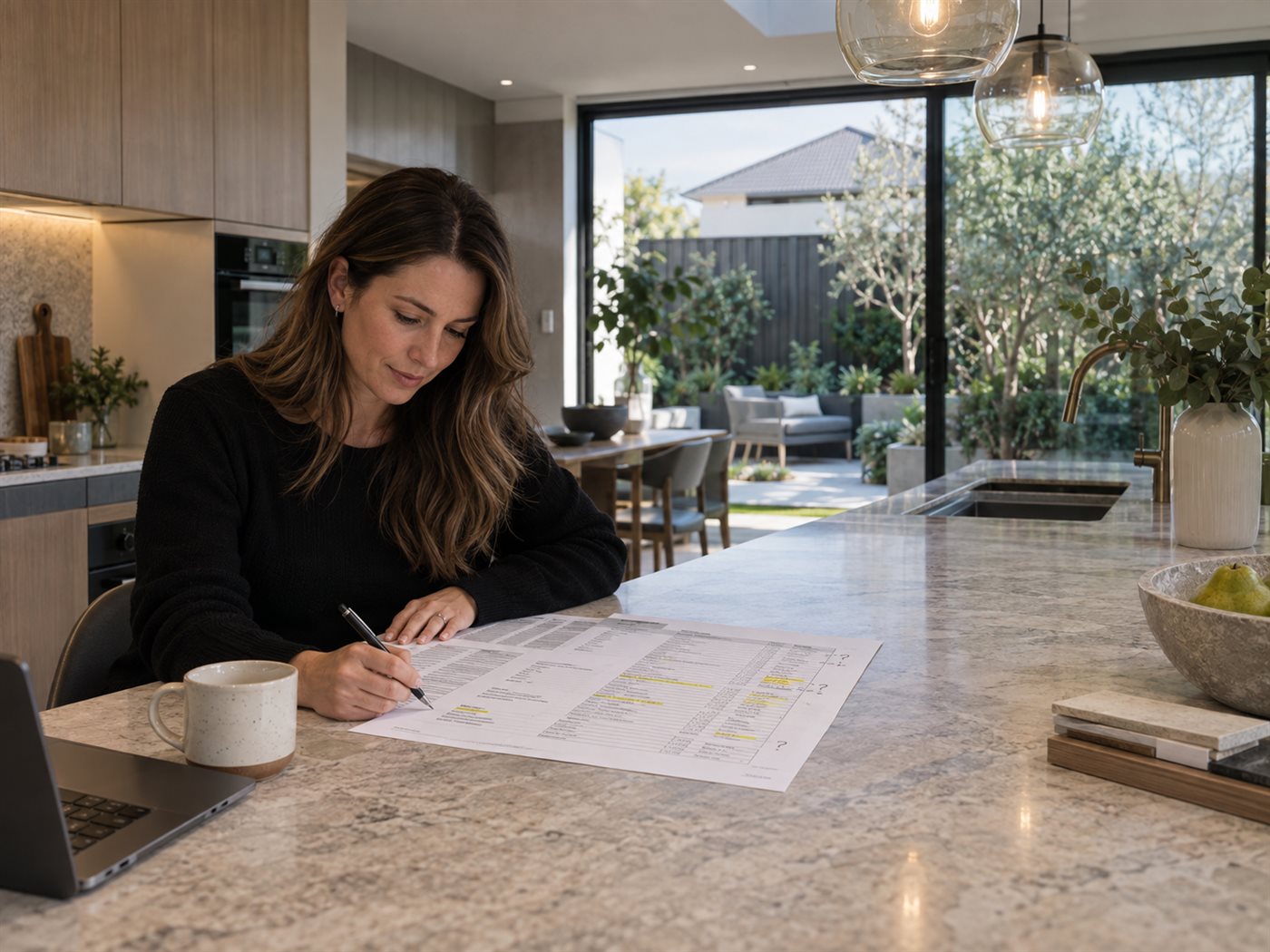
Between design and contract sits the specification, where the volume model's cost advantage often turns out to be smaller than advertised.
The Victorian building regulator publishes a plain warning: "Display homes often include specifications that are optional upgrades, such as high-end appliances." And on liability: "The builder must deliver everything that's specified in the contract. If not listed, they will need to be supplied and fitted at your expense."
Its guidance on what to name in your contract lists what homeowners most often assume is included when it is not:
Every one of those is visible in a display home. None is automatically in a contract. Walk a display, note what you assumed, then check each assumption against the specification schedule. Anything you cannot find is either a variation later or a purchase at your own cost.
Apply the same discipline to a custom builder. With no display home and no standard range, the specification has to be written out in full or the builder cannot price the job.
You have a cooling-off right of five business days from the day you receive a signed copy of a major domestic building contract. Exercise it and you are refunded your deposit less $100 and any approved out-of-pocket expenses the builder has incurred.
There is one trap. Consumer Affairs Victoria states in its cooling-off guidance that the right is lost if you engaged a lawyer to review the contract before signing. On a high-value custom build, legal review is almost always worth more than the right you give up.
A volume builder's advertised timeline is shorter, and on a straightforward site it usually is shorter in practice. Repeated plans mean known trade sequences, pre-ordered materials and fewer decisions to make on site.
A custom build adds design time at the front, and design time is real time: concept, documentation, engineering, then building permit approval before a single trade arrives.
The two models then absorb change differently. A volume build runs fast while nothing deviates and slows sharply when something does. A custom build runs slower at first and more predictably later, because the decisions that cause mid-build stoppages were made months earlier. Our guide to how long it takes to build a house in Melbourne sets out the stage-by-stage picture.
Variations connect time to money, and Victorian law treats them formally. Most require a variation notice signed by both parties. A notice is not required only where the owner requests the change and the builder believes it will not require a permit change, cause delay, or add more than 2% to the original contract price.
Anything of consequence is therefore a documented contract event, not a site conversation. If you are signing variation notices steadily from frame stage onward, the specification was unfinished when the contract was signed, whichever model you chose.
Victorian domestic building contracts carry six statutory warranties, and they attach to the contract itself:
Separately, Home Warranty insurance is required for eligible domestic building work valued over $20,000 from 1 July 2026, with maximum cover of $400,000 per home. It replaced Domestic Building Insurance, which applied over $16,000 with $300,000 cover. The Building and Plumbing Commission publishes the detail on its Home Warranty page.
The commonly quoted "six years for major defects, two years for other defects" belongs to the insurance, not to the statutory warranties. They are different instruments with different triggers, and plenty of published advice conflates them.
The Victorian Building Authority and Domestic Building Dispute Resolution Victoria no longer exist as separate bodies. Since 1 July 2025 their functions sit with the Building and Plumbing Commission, so guidance still citing the VBA is out of date.
Budget, timeline, lifestyle, site and long-term value are the right five subjects. Here they are as questions a builder must answer with a document, not an opinion.
A builder who answers all five from the documents in front of them prices their work properly. One who answers with reassurance is asking you to fund the difference later. We have expanded these in questions to ask a builder before you sign.
For a flat, regular block and a buyer happy inside a standard range, the volume model is usually cheaper.
On a sloping, treed or boundary-constrained block, every deviation from the standard product is priced as an exception, and exceptions to a fixed product are the most expensive way to buy a house. The custom model prices the exception as the design, once, at the start.
No. On a flat, regular block, with a buyer content inside a standard selections range, the volume model usually wins on price. On a sloping or constrained site, every alteration to the standard design is charged as an exception to a fixed product, which narrows the gap and can close it.
A prime cost item is a product you have not chosen yet, such as a tap or a cooktop, carried as an estimated allowance. A provisional sum is work nobody has priced, such as excavation on unknown soil. Both mean part of your contract price is still an estimate.
Consumer Affairs Victoria sets the maximum at 5% of the contract price for contracts of $20,000 or more, and 10% under that figure. Every custom home falls into the first category, so a request above 5% is not a negotiating position, it is a term the law does not allow.
Not through a cost escalation clause. Those clauses are prohibited in Victoria below a contract price of $500,000, and above it they need the Director of Consumer Affairs Victoria's approval, which the department states has not yet been granted. Prices still move through variations, prime cost items and provisional sums.
Yes. The five business day cooling-off period on a major domestic building contract does not apply if you engaged a lawyer to review it before you signed. On a high-value custom build that review is usually worth more than the right you give up, but make the trade deliberately.
The figure that decides this is not the headline on either quote. It is the total value of everything in the contract that is not yet fixed: the prime cost allowances, the provisional sums, and the specification items that are still assumptions. Add those up on both quotes and you have compared the models properly.
If you are weighing a custom build on an established Melbourne block, talk to ROMAAC Group about what a fully specified contract for your site would contain.


